This post contains affiliate links.
If you have spent any time researching the best blenders for smoothies, you have probably run into two names again and again: Cleanblend and Vitamix. Both have strong reputations, both promise restaurant-quality results at home, and both show up constantly in kitchen reviews and TikTok make-it-yourself smoothie videos. But they sit at very different price points, and the gap between them raises an obvious question. Are you paying for performance, or are you paying for a name?
I have spent years blending everything from green smoothies to hot soups, and I want to walk you through the real differences. This is not a spec sheet read aloud. It is a practical look at how these two high-performance blenders actually behave when you are standing in your kitchen at 6 a.m. trying to get breakfast made before the day starts. By the end, you will know which is the right blender for your counter, your budget, and your morning smoothie routine.
## The Short Answer First
If you want the quick version: Vitamix is the more refined, better-supported, and more versatile machine, and it is the better choice if you blend daily and want a blender you will not think about replacing for a decade or more. Cleanblend is the value play. It delivers something genuinely close to Vitamix performance for a fraction of the cost, and for a lot of people it is the smarter buy.
Neither is a bad blender. The question is which one is the best fit for you. Let me explain why, because the details matter and the key differences are not always where you would expect.
## Meet the Contenders
### Vitamix Blenders
Vitamix is the brand most people picture when they think of high-end blenders. The company has been making commercial-grade kitchen appliances for decades, and the Vitamix models you can buy for your home are essentially detuned versions of what smoothie shops and restaurants use all day, every day. The classic 5200, the Explorian series, the Ascent line with its smart features and touchscreen control panel, and the various personal blender configurations all share the same core DNA: a powerful motor, a tall container, and a variable speed dial that gives you precise control over texture.
A typical full-size Vitamix runs a 2.0 to 2.2 hp motor. That is plenty of power for almost anything you will throw at it, including frozen fruit, ice, nut butters, and fibrous greens. The brand's reputation is built on durability and customer service, and that reputation is largely earned. A Vitamix is one of the few kitchen appliances people genuinely keep for fifteen or twenty years.
### Cleanblend Blenders
Cleanblend is a younger, more direct-to-consumer brand that built its name by offering high-performance specs at a much more affordable price. The flagship Cleanblend blender advertises a 3.0 hp motor, a 64-ounce BPA-free container, stainless steel blades, and a tamper, all of which sounds like it should outmuscle a Vitamix on paper.
Here is where you need to read carefully, though. The horsepower number on the front of the machine, and the specification of the motor in general, seems impressive, but peak horsepower and sustained horsepower are very different things. The 3.0 hp on a Cleanblend is a peak figure measured under specific conditions, not the continuous output the motor produces during a normal blend. Vitamix is more conservative in how it states its motor power, which is part of why a "lower" Vitamix number often outperforms a "higher" Cleanblend number in practice. Motor power is the blender's most important feature, but the headline horsepower figure is one of the most misleading numbers in the entire category.
That said, the Cleanblend base is a genuinely capable unit. This is not a cheap knockoff dressed up with a big sticker. It is a real high-powered blender that performs far above its price range.
## Round One: Smoothie Performance
Since the whole question here is which blender makes the best smoothie, let's start there.
### Green Smoothies
A green smoothie is the toughest everyday test for any blender. Kale, spinach, and other leafy greens have tough cell walls and stringy fibers that lower-end blenders leave in chewy little ribbons. To break those down into a smooth consistency you need real blade speed and good produce circulation inside the container.
Both machines handle a green smoothie well, but the Vitamix produces the smoothest smoothies of the two by a small margin. The difference comes down to container design and blade design working together. The Vitamix container creates an aggressive vortex that pulls everything down into the blades repeatedly, and the trailing edge of the blades is shaped to keep that downward-impelled liquid moving. The Cleanblend gets you ninety-five percent of the way there. For most people that last tiny bit of smoothness is not worth the price difference, but if you are sensitive to texture, you will notice it.
### Frozen Fruit and Ice
This is where higher speeds and a powerful motor earn their keep. Both blenders crush ice and frozen fruit without complaint. If you like a thick smoothie with very little liquid, both can manage it, though you will want to use the tamper to keep things circulating. The Cleanblend includes a tamper, and so do most Vitamix models, which matters because at high speeds with minimal warm water or juice in the jar, a frozen mix can form an air pocket and stop moving against the blades. This is a common problem with every high-performance blender, not a flaw specific to either brand.
### Nut Butters
Peanut butter, almond butter, and other nut butters are a serious test of sustained power. Grinding nuts into a smooth spread means running the motor hard for a couple of minutes while the mixture goes from dry crumbs to a thick paste. Here the Vitamix pulls ahead more clearly. Its motor handles the heat and load of a long nut-butter run more comfortably, and the container geometry circulates the thick mass better. The Cleanblend can make peanut butter, but you will be working the tamper harder and stopping to scrape down the sides more often.
## Round Two: Versatility Beyond Smoothies
A high-quality blender should do more than smoothies, and both of these machines reach well beyond the breakfast cup.
### Hot Soups
One of the most impressive party tricks of high-performance blenders is making hot soups from cold ingredients. Run the blender on its highest setting for five or six minutes and the friction of the blades heats the soup to steaming. Both the Vitamix and the Cleanblend can do this. Just be careful with hot liquids in general: never seal the lid completely when blending anything warm, because steam pressure can blow the lid off. Both brands include vented lids designed for exactly this.
### Ice Cream and Frozen Desserts
Using frozen fruit and a little liquid, both blenders can produce a soft-serve-style ice cream in seconds. This is one of those unique features people forget high-performance models can do. Piña coladas, frozen margaritas, and other blended drinks are equally easy. If you entertain, this is a genuine selling point for either machine.
### Grinding, Chopping, and Doubling as Food Processors
Neither of these is a true food processor replacement, but both can chop, grind grains into flour, and handle smaller quantities of prep work. If counter space is at a premium and you cannot justify both a blender and a food processor, a high-performance blender covers a surprising amount of ground. For serious chopping in larger volumes, though, dedicated kitchen appliances still win.
## Round Three: Ease of Use and Daily Living
Specs win arguments online, but ease of use is what determines whether you actually reach for the blender every morning or let it gather dust.
### Controls
The Vitamix variable speed dial is one of the best control panels in the category. It is intuitive, it ramps smoothly from very slow to very fast, and the better models add pulse and preset programs. The Cleanblend uses a similar variable speed dial with a pulse function. Both are easy to learn. The Vitamix simply feels a little more polished, and the higher-end Vitamix models with digital controls and timers add advanced features the Cleanblend does not match.
### Cleaning
Both brands tout a self-cleaning feature, and it works on both. Add a drop of dish soap and warm water, run on high for thirty to sixty seconds, and rinse. It is one of the genuine joys of owning a high-performance blender. The polycarbonate containers on both machines resist the scratched-plastic cloudiness that plagues lower-end blenders, though over years of use any plastic container will show some wear. If you strongly prefer glass containers, note that neither of these primarily ships with glass, which is something to weigh if that matters to you.
### Noise Levels
Let's be honest: every powerful blender is loud. Both of these will wake a sleeping household. The Vitamix is marginally quieter at slower speeds, but at full power both produce serious noise. This is the price of plenty of power, and it is true of competing blender brands too.
### Footprint and Small Spaces
Full-size models of both blenders are tall, often too tall to live under a standard upper cabinet. If you have small spaces to work with, measure your clearance before buying. Both brands offer lower-profile options. Vitamix sells low profile containers and shorter configurations, and there are personal blenders in the Vitamix lineup for tighter kitchens. The little rubber feet on the base of both units keep them stable during a hard blend, which matters more than you would think when you are crushing ice.
## Round Four: Build Quality and Longevity
### The Base Units
Both base units feel solid and heavy duty. The Cleanblend base has real weight to it and does not walk across the counter. The Vitamix base is famously overbuilt. When you compare these two against the lower-end blenders and many personal blenders on the market, the difference in construction is obvious within seconds of holding them.
### Blades
Both use stainless steel blades in a robust blade assembly. The blade design differs slightly in the angle and the trailing edge geometry, and this contributes to the different levels of blender cavitation each produces. Cavitation is that air-pocket problem where the blend stops circulating, and better blade and container design reduces it. The Vitamix system, particularly the way liquid is downward-impelled back toward the bottom of the container, manages cavitation a tiny bit better, which again is part of why it edges out the Cleanblend on the smoothest smoothies.
### Durability and Warranty
This is one of the clearest key differences. Vitamix backs its machines with long warranties, often five to ten years depending on the model, plus a customer service operation with a strong reputation for actually honoring claims and repairing units. Cleanblend offers a solid warranty too, generally around five years, and customer service reports are mostly positive, but it does not have the decades-long track record Vitamix has built. If you are buying a blender you expect to keep through years of use, that history has real value.
## Round Five: Price
Here is where Cleanblend makes its strongest argument. A flagship Cleanblend typically costs a fraction of what a comparable Vitamix costs. The most expensive blender in the Vitamix lineup, with all the smart and advanced features, can cost three to four times what a Cleanblend does.
So the honest framing is this. If money were no object, the Vitamix is the better blender. But money is usually an object, and when you factor price into the equation, the Cleanblend becomes one of the best-value high-performance blenders you can buy. You are getting maybe ninety to ninety-five percent of the performance for forty to fifty percent of the cost. For a lot of households, that is clearly the better choice.
## How They Stack Up Against Other Blender Models
It helps to place these two within the wider field of blender brands, because Cleanblend and Vitamix are not the only names worth knowing.
The Blendtec Total Classic is the other true top-tier competitor alongside Vitamix. It uses a blunt, wing-shaped blade instead of sharp stainless steel blades and a square jar, and it is a genuinely excellent high-performance blender. If you are cross-shopping, it deserves a look.
The Ninja family, including the Ninja Professional BL series and various Ninja blender models, sits a step below in price and performance. A Ninja is a decent blender and a good blender for the money, with plenty of power for everyday smoothies, but it does not match the smooth consistency or longevity of a Vitamix or Cleanblend on the hardest tasks. Ninja also makes capable personal blenders if a small container single-serve setup is all you need.
The Oster Versa is an underrated high-performance option at a lower price than either of our two main contenders. It is a less expensive option that punches above its weight, though its motor power and build do not reach Cleanblend or Vitamix levels.
The KitchenAid K series blenders are solid mid-range kitchen appliances with strong design, but they are not in the same high-powered class. They are better understood as everyday blenders than as Vitamix rivals.
And of course there is the entirely different category of the immersion blender, the handheld stick style. An immersion blender is wonderful for blending hot soups right in the pot and for smaller quantities, and it stores in a drawer, but it cannot make a thick smoothie or crush ice the way a countertop high-performance blender can. If you make a green smoothie every day, an immersion blender is not the right tool. If you mostly puree soups, it might be all you need.
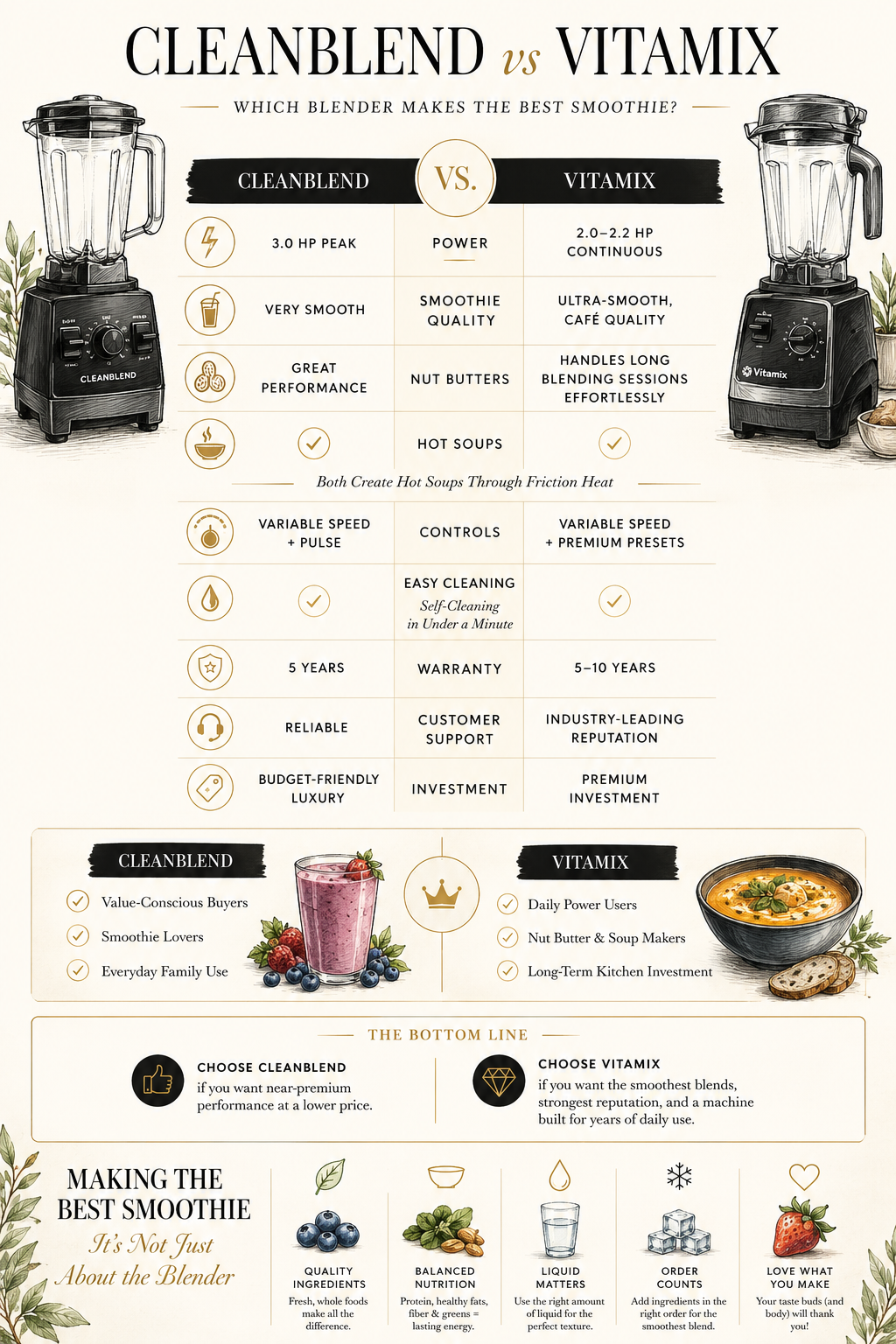
Here is something the spec wars miss. Even the most powerful blender cannot fix a poorly built smoothie. The order you load the jar, the ratio of liquid to solids, and what you actually put in matter as much as the machine.
A reliable method: liquid first, then soft ingredients, then greens, then frozen fruit and ice on top. This gives the blades something thin to grab immediately and creates the vortex that pulls everything else down. Start on low, ramp to high through the variable speed dial, and use the tamper if the mix is thick. Both of our blenders reward this technique with a smooth consistency.
This is also a natural place to talk about what goes into the smoothie nutritionally, because a lot of people buying a high-performance blender are doing it as part of a health routine, not just for piña coladas.
### Where Farmasi Meal Replacement Shakes Fit In
If part of why you are upgrading your blender is to support a wellness or weight-management goal, a meal replacement shake can be a convenient anchor for your routine. I personally like blending Farmasi meal replacement shakes because the powder mixes cleanly and pairs well with whatever produce I have on hand. A typical blend for me is the shake powder, a cup of unsweetened almond milk, a handful of spinach for a green smoothie effect you can barely taste, half a frozen banana, and a spoonful of almond butter or peanut butter for staying power.
Both the Cleanblend and the Vitamix turn that into a genuinely smooth, café-quality shake in well under a minute. The protein powder dissolves completely with no chalky grit, the greens disappear, and the frozen banana gives it that thick, almost ice-cream texture without needing added sugar. If you are building a daily shake habit, having a blender that produces a consistently smooth result every single time makes you far more likely to stick with it. A grainy, half-blended shake is the fastest way to abandon a routine. This is exactly the kind of everyday use case where spending on a high-quality blender pays for itself in consistency.
What I appreciate about the Farmasi shakes specifically is how flexible they are once you have a real blender behind them. On a busy weekday I keep it simple with just shake powder and almond milk, and even that minimal mix comes out silky rather than watery. On weekends I treat it more like dessert, adding cocoa, a spoonful of peanut butter, and extra frozen fruit, and the high-performance motor handles the thicker load without straining. Because the powder blends so cleanly, you can experiment freely without worrying about clumps surviving at the bottom of the container. That reliability is what turns a meal replacement from an occasional thing into a genuine daily routine you actually look forward to, and it is where a powerful blender quietly earns its place on the counter.
## So, Which Should You Buy?
Let me give you clear guidance instead of a wishy-washy "it depends."
Buy the Vitamix if: you blend every single day, you make a lot of nut butters or run long hot-soup cycles, you want the absolute smoothest smoothies, you value the longest warranty and the strongest customer service reputation, and the price premium does not strain your budget. It is the best option for serious daily users and the machine least likely to ever need replacing. For many people it becomes the only blender they will buy for a decade or more.
Buy the Cleanblend if: you want ninety-plus percent of Vitamix performance at roughly half the price, you blend regularly but are not pushing the machine to commercial extremes, and you would rather put the savings toward other kitchen appliances or ingredients. It is the smartest value in high-performance blenders right now and a genuinely powerful blender that will serve most households beautifully for years.
Look elsewhere if: your needs are lighter. A Ninja blender, an Oster Versa, or a quality personal blender will save you money if you only make the occasional smoothie. And if soups in the pot are your main goal, an immersion blender in a drawer might be all you need.
For the specific question this article set out to answer, which blender makes the best smoothie, the technical winner is the Vitamix by a small but real margin, thanks to better produce circulation, smarter blade design, and more consistent motor power under load. But the Cleanblend makes a smoothie so close to it, at such a lower price, that for most readers it is the better choice overall. The right blender is the one that fits your budget and your routine, and either of these will make you a thick, smooth, café-quality smoothie tomorrow morning.
Whichever you choose, pair it with a good recipe and good ingredients, build the habit, and that new blender will pay you back one delicious green smoothie at a time.
As an Amazon Associate I earn from qualifying purchases. Product specifications and pricing can change, so always confirm current details on the product page before buying.